
· By OtsukiYozo
When Origin Countries Roast Their Own Coffee: Where Does the Value Stay?
From "countries that grow" to "countries that roast, drink and sell." The shift underway at origin is good news for producing countries, and a real question for the rest of us.
What this article explores
- Why most of coffee's value has traditionally been created outside producing countries
- How exporters, roasters and governments in Colombia, Kenya, Ethiopia and Uganda are changing that
- What it means for coffee-drinking countries, and how 2050 coffee wants to respond
For a long time, coffee has travelled the world along the same route.
It is grown, harvested and processed in producing countries. It is exported as green coffee, roasted in consuming countries, then sold under a brand in cafés and shops.
Most of the cups we drink every day still follow that route.
But it is starting to change. Producing countries are roasting their own coffee, designing their own packaging, opening cafés, building their own brands, and even selling roasted coffee directly abroad. These moves are spreading across many origins.
This is about more than a technique called "origin roasting." It is about a bigger question:
Where is coffee's value created, and who gets to keep it?
The short answer: this shift is healthy and positive for producing countries. At the same time, for the countries that drink most of the world's coffee, it quietly challenges an old assumption, that good coffee will simply keep arriving as it always has.
Coffee's value has mostly been created outside origin
Coffee is made on farms. Growing, harvesting and processing take the most work, and producing countries carry most of the weather risk.
Yet most of the value is usually added later: roasting, branding, retail and cafés. Sources such as the International Trade Centre's Coffee Exporter's Guide have suggested that producers receive only around 10% of the final retail price.
Of course, roasters and cafés in consuming countries have real costs too: roasting equipment, wages, rent, logistics, marketing and running a store. This is not a simple story of one side taking all the profit.
But structurally, the stages where the most value is added have long sat outside producing countries.
What changes when coffee is roasted at origin?
When producing countries take on roasting, retail and cafés, at least three things change.
The value stays local.
Roasting and selling under their own brands keeps value inside the country that was previously created elsewhere.
New jobs appear.
Roasters, quality control, packaging design, baristas, marketing, export operations and e-commerce. Work beyond farming takes root, and a whole coffee industry grows inside the country.
People can drink their own best coffee.
In many producing countries, the best coffee has traditionally been exported. In Ethiopia, specialty-grade lots have been set aside for export while lower grades stay at home. Visitors to coffee farms in Colombia have often been served instant coffee.
Growing the best coffee on your own land, then roasting and drinking it yourself, should be the most natural thing in the world.
Colombia: "Colombia deserves to drink its best coffee, too"
Azahar Coffee in Colombia is one of the clearest examples.
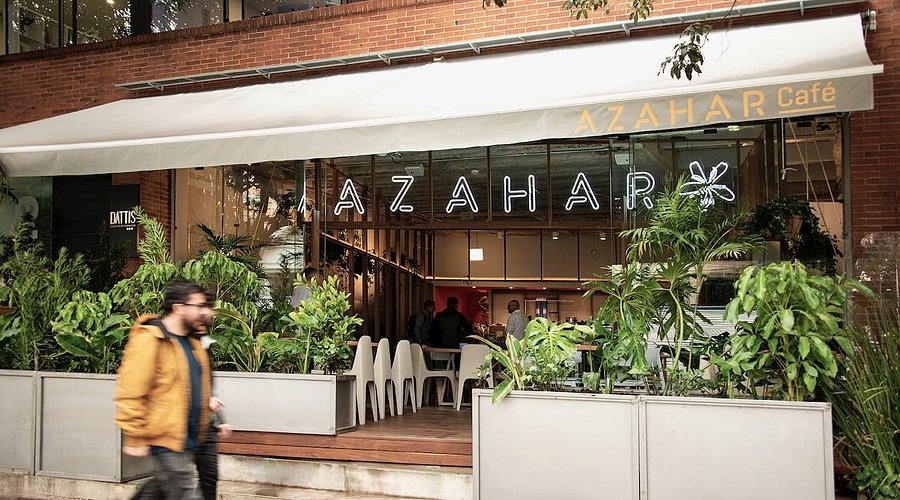
Azahar Coffee's café in Bogotá (Photo: Azahar Coffee)
Azahar buys directly from producers across Colombia and exports green coffee to well-known roasters abroad, including Stumptown Coffee Roasters and Blue Bottle Coffee.
At the same time, it runs its own roastery in Quindío and cafés in Bogotá. Its website puts it simply:
"Colombia has always exported its best coffee. … Because Colombia deserves to drink its best coffee, too."
Azahar is reported to work with more than 500 smallholder producers, paying a fixed premium of 50–70% above regional market prices.
Connecting with producers, exporting, roasting at home and serving in its own cafés: Azahar is no longer just a supplier of raw material. It is curator, brand and seller all at once.
Kenya: origin-roasted coffee on European shelves
Origin roasting is not a small idealistic project. It is already a working business at scale.
Kenya's African Coffee Roasters was founded by the Danish retail cooperative Coop Denmark. Its annual roasting capacity is about 2,200 tonnes: roughly 37,000 sixty-kilogram bags, or more than 100 shipping containers.
It produces whole beans, ground coffee and capsules in Kenya, and reportedly supplies more than 2,000 stores in Europe as private-label coffee. According to CBI, the Dutch development agency, 99.5% of the roasted coffee Denmark imports from producing countries comes from Kenya, much of it from African Coffee Roasters.
In Nairobi, Spring Valley Coffee has been roasting since 2009. It has expanded across the city, and in 2025 it opened its first café abroad, in London. Its website says that roasting at origin keeps more of the coffee's value in Kenya.
Instead of a London roaster selling Kenyan beans, a Kenyan brand is heading to London. The flow is starting to run the other way.
Ethiopia: when an exporter opens a café
When we visited Ethiopia, we went to see Moplaco, one of the country's best-known exporters, founded in the 1970s and a long-time partner of ours.
Moplaco does more than export green coffee. In Addis Ababa it also runs a café called Galani Coffee. The coffee it grows, processes and exports is also roasted and served in its own city.
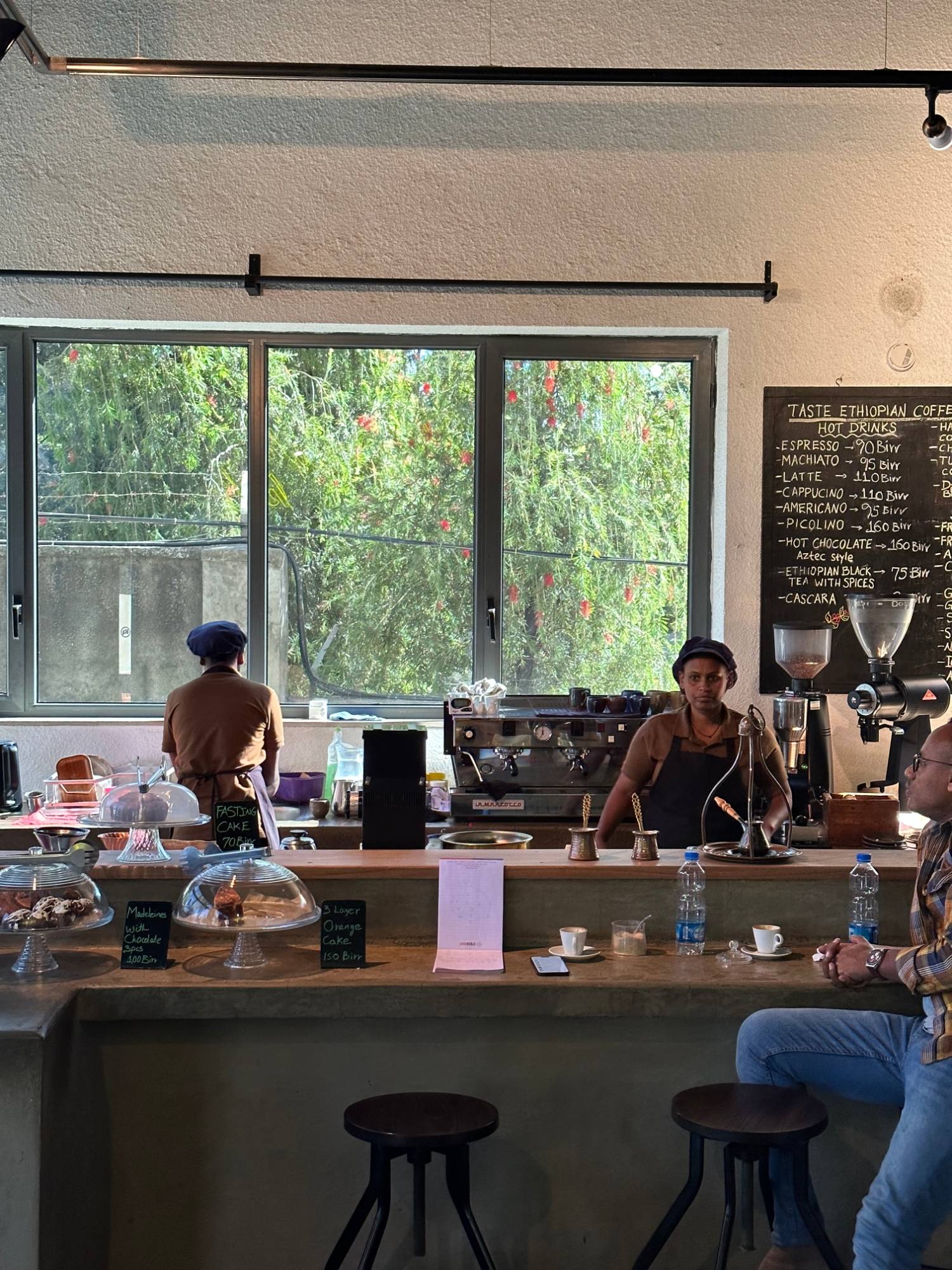
Galani Coffee in Addis Ababa
Seeing that, it felt completely natural. If anything, it made us ask why this had not always been the norm.
Countries are building a culture of drinking coffee
Companies are not the only ones driving this change.
In Kenya, there are reported plans to open coffee shops at public universities. According to Kenya's Agriculture and Food Authority, domestic consumption rose about 19%, from 1,722 tonnes in 2021/22 to 2,051 tonnes in 2022/23.
In Uganda, the Uganda Coffee Development Authority has donated espresso machines and grinders to universities across the country as part of its campaign to grow domestic consumption.
Young people drinking their own country's coffee every day: that is how a producing country becomes a coffee-drinking country too.
What changes for consuming countries?
For producing countries, this is a hopeful shift. What does it mean for everyone else?
If good coffee is enjoyed, and sells well, at home, there will be fewer reasons to choose the hard work of exporting it. Any country does the same with a staple crop when supplies run short at home.
Add rising demand from fast-growing coffee markets such as China and the Middle East, plus currency swings, and the assumption that consuming countries can keep buying the best coffee "as usual" starts to weaken.
We may be entering an era where it is not only buyers who choose, but sellers too.
Why sell to this roaster?
Why ship to this country?
Will this partner tell our coffee's story properly?
What brands in consuming countries can still do
None of this makes roasters and cafés in consuming countries unnecessary.
Most coffee drinkers around the world have never heard of Azahar or Galani. Many of the brands with direct relationships with everyday drinkers are still based in consuming countries.
Their role is to translate the value of origin and explain why a coffee is worth drinking; to keep buying over the long term; to introduce origin brands themselves; and to think about how value can be shared, rather than captured.
That, we think, is where the role of consuming-country brands is heading.
How 2050 coffee wants to keep value where it belongs
We do not want to see this change only as a frightening future in which good coffee becomes harder to get. A future where producing countries prosper and a future where people everywhere keep enjoying great coffee can, we believe, go together.
Building long-term relationships with origin: we want to do more than buy good coffee. We want to keep working with the same producers year after year and build on that relationship.
Translating the value of origin: origins, producers, processing methods, and the changes happening in each place. Sharing the story behind every cup is a core part of our work in the café.
Helping value stay at origin: in Indonesia, Southeast Asia and the other places we work, we want to explore how coffee can be roasted locally, enjoyed locally, and keep its value locally, and to build that together with local partners.
The future of coffee will not only be about where to find the best beans or who roasts them best.
Where does the value stay?
How much of it remains in producing countries?
And how do those of us who drink the coffee help tell its story and share its value?
Producing countries becoming places that roast, drink and sell their own coffee may feel unsettling to some. But at its heart, it is a hopeful future, and a step toward a healthier coffee system.
Build the future of coffee, together.
We also discuss this topic on our YouTube channel "FUTURE OF COFFEE" (in Japanese): https://youtu.be/NZPwkrlD5vY
SOURCES & FURTHER READING
- International Trade Centre, The Coffee Exporter's Guide
- IDH / GCP / Solidaridad, "The Grounds for Sharing"
- Azahar Coffee, About Us
- Acumen, Azahar Coffee Company
- African Coffee Roasters
- CBI, "European market potential for roasted coffee"
- Spring Valley Coffee
- Moplaco
- Galani Coffee, The World's 100 Best Coffee Shops
- Kenya News Agency, "Public universities to establish coffee shops"
- Agriculture and Food Authority (Kenya)
- Daily Coffee News, "Uganda Coffee Report"
- Perfect Daily Grind, "Roasting Coffee At Origin"