What this article explores
- Where the word "sustainable" actually comes from
- Four real cases: Starbucks, Nespresso, Nestlé, and the rise of "regenerative"
- What big companies genuinely do well, and where they fall short
- Whether small roasters are really any better
- Three questions to cut through sustainability claims
"200,000 more hectares under regenerative farming by 2030."
"Half of our coffee from regenerative agriculture by 2030."
"100% ethically sourced."
We see lines like these from big coffee companies all the time now. Sustainable, regenerative, ethical, carbon neutral.
But honestly, have you ever thought: really?
Our short answer: big companies' efforts aren't all fake. But there is still a wide gap between the words and what happens on the ground. And that gap isn't only a big-company problem. The same questions apply to small coffee brands like us.
Let's look at what's behind the words, case by case.
What does "sustainable" actually mean?
The definition goes back to Our Common Future, the 1987 report from a United Nations commission (known as the Brundtland Commission):
Development that meets the needs of the present without compromising the ability of future generations to meet their own needs.
The term was created to bridge a conflict between richer countries, which wanted environmental protection, and developing countries, which wanted to grow first. So from the start it was about more than the environment. It also included prosperity and fairness.
In coffee, that means at least three things:
- Environment: forests, soil, water, climate
- Livelihoods: can farmers keep going, and are workers treated fairly?
- Transparency: can you show where, by whom and how it was grown?
It's a useful word, which is exactly why anyone can use it. That's where we start.
Case 1 | Starbucks and "100% ethical sourcing"
The claim: Since 2004, Starbucks has run its own sourcing standard, C.A.F.E. Practices. Third parties verify farms on four areas: quality, economic transparency, social responsibility and the environment. Starbucks says 99% of its coffee is verified under the standard.
The criticism: In 2024, the National Consumers League, a US consumer group, sued Starbucks, arguing that "100% ethical" is misleading. The suit cites reported labor abuses at supplier farms in Guatemala, Kenya and Brazil. Starbucks has said it will defend itself, and as of October 2026 we could find no ruling.
To be fair, building its own standard back in 2004 was ahead of its time for a company that size. But having a standard is not the same as every farm meeting it. With more than 400,000 farmers in the supply chain, guaranteeing that is hard.
Case 2 | Nespresso drops paper capsules
The claim: In 2023, Nespresso launched home-compostable capsules made of more than 80% paper-based material across 14 European markets. In 2022 it also became a certified B Corp, a certification for companies meeting social and environmental standards.
The criticism: When it was certified, more than 30 B Corp companies protested in an open letter, citing the single-use capsule model and past supply-chain issues. Then, in September 2026, Nespresso announced it would stop selling the paper capsules and focus on aluminum, citing consumer feedback on freshness and usability (paper capsules needed to be used within four weeks of opening).
Nespresso says this isn't a step back on sustainability. Its own life-cycle analysis puts an espresso at 79g of CO₂ equivalent with paper and 81g with aluminum, almost no difference.
What this case shows is the trade-off between ideals and business reality. It also shows how a certification can make something look "done" when it isn't, which is a risk of its own.
Case 3 | Nestlé walks back "carbon neutral"
The claim: Nestlé had promoted some brands, such as KitKat and Perrier, as carbon neutral.
The criticism: In 2023, Nestlé stopped making those claims, amid criticism of relying on carbon credits (paying for emission cuts somewhere else). It has since shifted to reducing emissions within its own supply chain.
Carbon neutrality can, surprisingly, be bought. Is a company actually cutting emissions, or balancing the books? From the drinker's side, it's almost impossible to tell.
Case 4 | The rise of "regenerative"
"Regenerative" is now showing up where "sustainable" used to be. The idea is to go beyond doing less harm and actively restore soil, biodiversity and water.
- In January 2026, JDE Peet's, one of the world's largest coffee companies, announced plans to expand regenerative farming to 200,000 more hectares by 2030 and reach 100% responsibly sourced coffee by 2028 (up from 83.2% in 2024).
- Nescafé has set a goal of sourcing 50% of its coffee from regenerative agriculture by 2030.
The direction is positive. But there's a catch: regenerative agriculture still has no shared global definition or way of measuring it. What counts as regenerative? Who pays for the transition? Without answers, this word may go the same way as "sustainable."
So are big companies the bad guys?
It isn't that simple.
There are things only big companies can do:
- Map farms and forests across tens of thousands of smallholders using satellites and AI
- Deliver training and seedlings to hundreds of thousands of farmers
- Give farmers stability by buying large volumes every year
- Fund research into climate-resilient varieties
Scale gives them breadth.
They have weaknesses too. Relationships with individual farmers tend to be thin, and prices usually follow the market. They can report "X% of farmers adopted this practice," but rarely "this is how this farmer's life changed." And their words easily turn into advertising.
Are small roasters really any better?
Honestly, not necessarily.
Most small roasters have no third-party verification and no large-scale data. "We value our relationships with producers" can be just as empty as a big company's "sustainable" if nothing backs it up.
If big companies are good at breadth, what small roasters owe is depth:
- Seeing and understanding what happens at origin first-hand
- Paying prices that reflect quality and let producers keep going
- Sharing the difficulties as well as the good news
Different roles, same question.
Three questions to cut through "sustainable"
So what should drinkers look for? We find three questions useful, for big companies and for ourselves.
1. Does it stop at "we're sustainable"?
What exactly is sustainable, how, and to what extent? Is it specific?
2. Who is paying the cost?
Is the cost of doing good being pushed onto the people with the least power, often the farmers?
3. Do they talk about what's hard?
Brands that are serious rarely claim everything is perfect. Being able to talk about problems is one sign of honesty.
So what is sustainability, in the end? We'd put it this way: everyone involved can keep doing it next year. Farmers still want to grow coffee next year. The land can still bear fruit. Cafés can keep buying at that price. Drinkers keep seeing the value. If any one of those is under strain, it isn't sustainable.
What 2050 coffee is working toward
2050 coffee exists to build a future where we can still enjoy coffee in 2050. We look at the innovations shaping that future across five areas: species, variety, farming, process and origin.
1. Choose coffee by what's done, not what's said
In farming, for example, there are producers like FAF (Fazenda Ambiental Fortaleza) in Brazil, which gave up synthetic pesticides more than 20 years ago and has planted native trees to turn the farm back into forest. We choose coffee by what's happening on the ground, not by the words on the label.
2. Tell the story behind the cup, including what's hard
What does an effort really mean, and where are the challenges? We try to share both, honestly.
3. Widen the way in to new coffees
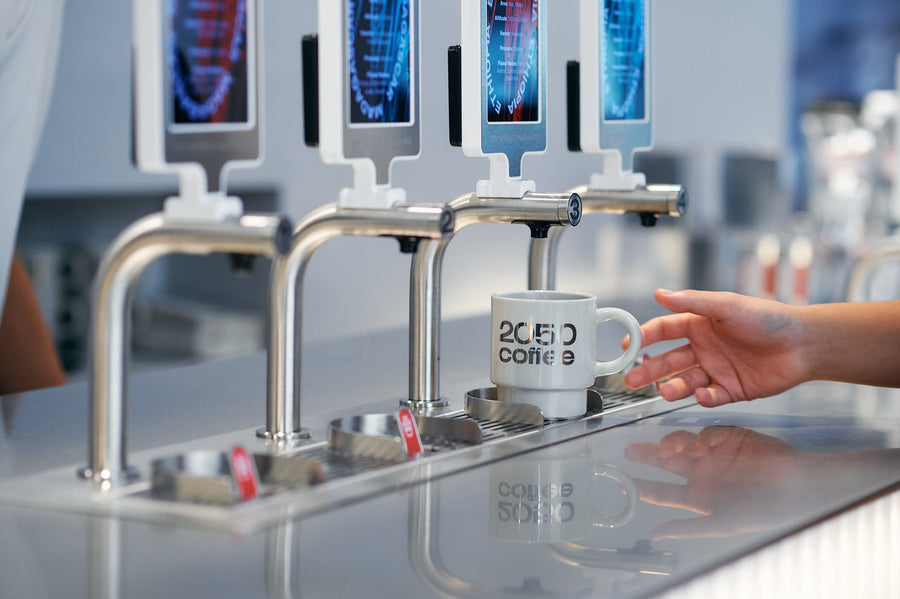
Even the best effort can't last if nobody drinks the coffee. The 2050 coffee taps are an easy way to try coffees like these. The time technology saves us, we spend talking with you about what's in the cup.
What matters is less saying "we're sustainable" and more being able to explain what you mean by it. We think that's the question coffee now has to answer.
Build the future of coffee, together.
We talk about this in more depth in our Future of Coffee video on YouTube (in Japanese).
SOURCES
- World Commission on Environment and Development (1987) Our Common Future
- National Consumers League v. Starbucks (filed 2024), as reported by NBC News https://www.nbcnews.com/news/us-news/starbucks-sued-allegedly-using-coffee-farms-rights-abuses-touting-ethi-rcna130393
- Starbucks, C.A.F.E. Practices / Ethical Sourcing https://www.starbucks.com/responsibility/sourcing/coffee
- Daily Coffee News, "Citing Quality, Nespresso Discontinues Compostable Capsules" (October 8, 2026) https://dailycoffeenews.com/2026/10/08/citing-quality-nespresso-discontinues-compostable-capsules/
- Packaging Europe, "Why is Nestlé discontinuing its paper-based Nespresso capsules?" (2026) https://www.packagingeurope.com/why-is-nestle-discontinuing-its-paper-based-nespresso-capsules/
- swissinfo.ch, "Nespresso is phasing out its compostable paper capsules" (September 2026) https://www.swissinfo.ch/eng/agribusiness/nespresso-is-phasing-out-its-compostable-paper-capsules/92142073
- Daily Coffee News, "JDE Peet's Unveils Nature Transition Plan Tied to Coffee Sourcing" (January 29, 2026) https://dailycoffeenews.com/2026/01/29/jde-peets-unveils-nature-transition-plan-tied-to-coffee-sourcing/
- Nestlé / Nescafé Plan 2030 https://www.nestle.com/
- Reporting on Nestlé withdrawing its carbon-neutral claims (2023)
- Fazenda Ambiental Fortaleza (FAF) https://2050.coffee/pages/origin
- Future of Coffee, "Is big coffee's 'sustainable' real? Inside Starbucks, Nespresso and Nestlé" (YouTube, October 31, 2026, in Japanese)