What this article explores
- What robusta is, and why it has been coffee's "supporting actor"
- What makes a robusta "fine"
- What new research says about robusta and heat (it's not as simple as you think)
- How prices and exports are already shifting
- Why the future isn't arabica versus robusta
"Robusta? Isn't that the cheap stuff in instant coffee?"
If you love coffee, you've probably thought this at least once. For decades, specialty coffee has revolved around arabica.
But robusta now has a new word in front of it: fine. And large coffee companies have started presenting it as a "future-minded" cup. On October 1, International Coffee Day, UCC, one of the world's largest coffee groups, launched a limited iced coffee at its Ueshima Coffee Ten café chain, made entirely with fine robusta from the Tamba farm in Vietnam. The announcement framed it squarely around the coffee 2050 problem, as "a new choice for the future of coffee." When a mainstream café chain presents fine robusta as a cup for the future, something has shifted.
Our short answer: fine robusta is neither a cheap substitute for arabica nor a magic bean that solves climate change. But it is an important prompt to question one assumption: that good coffee means arabica.
Robusta is about 40% of the world's coffee
There are many species of coffee, but almost everything we drink comes from two: arabica and canephora, usually called robusta. Robusta accounts for roughly 40% of global production. Vietnam is the largest producer, followed by Brazil, Indonesia and Uganda.
Robusta is grown so widely because it is easier to farm:
- It grows at lower altitudes
- It is relatively resistant to disease and pests
- It yields more, and carries more caffeine
Its reputation in the cup has been less kind: bitter, rubbery, flat. So it mostly ended up in instant coffee, ready-to-drink cans, and espresso blends as the "body" component, rarely named on the label.
In volume, robusta has held up the world's coffee supply. In value, it has always been the supporting actor.
What makes a robusta "fine"?
Fine robusta is robusta that scores above a set threshold on a shared quality scale. Around 2010, the Coffee Quality Institute (CQI) and the Uganda Coffee Development Authority, among others, developed robusta-specific grading standards, and in 2012 certification began for Q Robusta (R) Graders.
The key insight: much of robusta's bad reputation came not from the species itself, but from how it was handled.
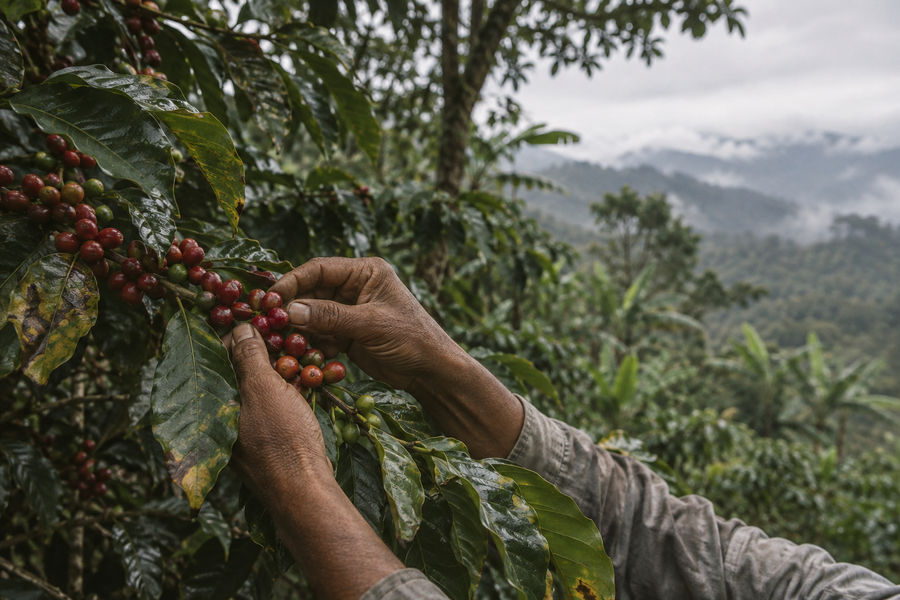
- Unripe cherries harvested alongside ripe ones
- Careless drying and storage
- No price premium for quality, so no reason to invest the effort
Treat arabica that way and it won't taste good either. Fine robusta means selective picking, careful processing and proper evaluation, and the result can be robusta with nutty, cacao and brown-sugar sweetness. The Ueshima Coffee Ten lot, picked as ripe cherries only and yellow-honey processed, is described as having cashew-like roastiness and a lingering, sugarcane-like sweetness.
The grading system itself is changing too. Since October 2025, the Q Grader program has been run by the Specialty Coffee Association (SCA), built on its newer Coffee Value Assessment framework, and robusta graders are included. When how we evaluate changes, what we call delicious slowly changes with it.
Will climate change make robusta the main act?
The biggest reason fine robusta is getting attention is climate.
Arabica is sensitive to heat. Rabobank estimates that around 20% of today's arabica-growing land could become unsuitable by 2050. So you often hear that heat-tolerant robusta is the answer. (We unpack the "half of coffee land" projection in What Is the Coffee 2050 Problem?)
There's truth in that. But it isn't that simple.
A 2022 study in Global Change Biology (Kath et al.) analyzed ten years of data from roughly 800 farms across Asia. It found that robusta's optimal mean annual temperature was about 20.5°C (69°F), well below the 22–30°C range previously assumed, and that yields fell by about 14% for every 1°C above that. The paper's title says it all: "Not so robust."
In other words:
- Robusta is more heat-tolerant than arabica. That's true.
- But "robusta will be fine as it gets hotter" is not.
- Robusta is also exposed to climate risk.
It's more accurate to see fine robusta not as an escape route, but as one way to widen our options.
It's no longer "cheap"
Prices and trade are shifting too.
Robusta futures climbed to record highs above US$5,000 per tonne through 2024 and early 2025, and were still trading around US$3,300 per tonne in April 2026. In the market, "robusta = cheap" no longer holds.
Exports are moving as well. According to the International Coffee Organization, in the 12 months to February 2026 arabica exports fell from 86.42 to 83.63 million bags, while robusta rose from 51.9 to 59.15 million bags. In the first five months of the 2025/26 coffee year, arabica's share of green coffee exports dropped from 65.1% to 60.9%.
Before we've even finished debating whether robusta's moment will come, the supply chain is already moving.
And if robusta is valued for quality, that matters for the people who grow it. A coffee that could only be sold on volume could start being chosen for what's in the cup, which can change how much value stays with producers.
The future isn't arabica versus robusta
So will robusta replace arabica?
We don't think so.
What's happening isn't a contest. It's a redesign: which species, which varieties, and which combinations can deliver great flavor.
- World Coffee Research has formally brought robusta into its global breeding network
- F1 hybrids are being developed to combine arabica's flavor with disease resistance
- Lesser-known species like liberica and stenophylla are being studied as heat-tolerant options for the future
Arabica isn't going away. But the idea that arabica is the only right answer for delicious coffee is clearly being shaken.
What we can do as drinkers
No need to overthink it. Try one with an open mind.
- Is robusta really "just bitter"?
- What's different from arabica, and what's surprisingly similar?
- Where was this cup grown, by whom, and how?
Our sense of "delicious" grows with experience. Tasting a fine robusta is also a way of getting to know one of coffee's future options.
What 2050 coffee is working toward
2050 coffee exists to build a future where we can still enjoy coffee in 2050. We look at the innovations shaping that future across five areas: species, variety, farming, process and origin. Fine robusta and liberica belong to the first: species.
1. Look beyond arabica
We don't want to limit what "delicious" can mean by species or variety. Coffees that have long played a supporting role, like fine robusta, deserve a serious look.
2. Tell the story behind the cup
Why this species? Why this process? The newer a coffee is, the more it needs explaining, or it stays "that strange thing I didn't get." So we put real care into sharing the reasons behind each cup.
3. Make new coffees easy to try
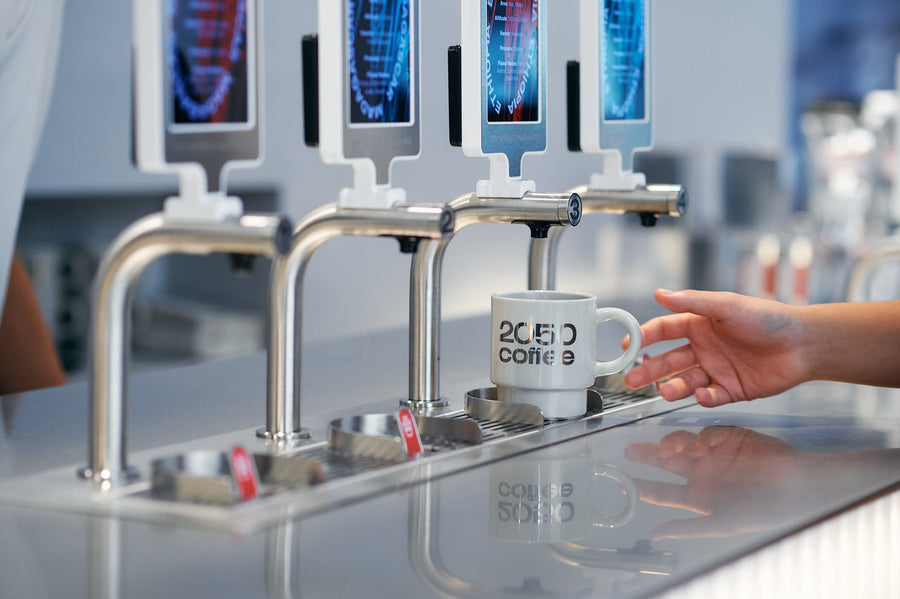
Paying for a bag of a coffee you've never heard of takes courage. The 2050 coffee taps are an easy way in. The time technology saves us, we spend talking with you about the coffee.
A coffee long dismissed as "cheap" might become a cup of the future. We'd love to watch that change happen with you.
Build the future of coffee, together.
SOURCES
- UCC Ueshima Coffee, "Ueshima Coffee Ten proposes a cup for the future with fine robusta, looking ahead to the 2050 problem" (September 28, 2026, in Japanese) https://www.ucc.co.jp/company/news/2026/rel260928.html
- Kath, J. et al. (2022) "Not so robust: robusta coffee production is highly sensitive to temperature." Global Change Biology
- International Coffee Organization, Coffee Market Report (March 2026)
- Reuters / Rabobank: outlook for arabica-suitable land to 2050 (2026)
- Uganda Coffee Development Authority, Daily Coffee Market Report (April 15, 2026) https://ugandacoffee.go.ug/
- Coffee Quality Institute, FAQ (transition of the Q Grader program to the SCA) https://www.coffeeinstitute.org/about/faqs
- Coffee Strategies, "R Grader certification to begin at CQI" (2012) https://www.coffeestrategies.com/2012/07/10/r-grader-certification-to-begin-at-cqi/
- World Coffee Research: integrating robusta into its global breeding network (2025); F1 hybrids https://worldcoffeeresearch.org/
- Future of Coffee, "Is the era of 'good coffee = arabica' ending?" (YouTube, June 2026, in Japanese)