Most of us have heard the words “El Niño” in a weather forecast.
But what does it actually mean—and how can a shift in ocean temperatures thousands of kilometers away affect coffee farms, global supply, and the price of the cup we drink?
El Niño begins with unusually warm surface waters in the central and eastern equatorial Pacific. That change can reshape winds and rainfall patterns around the world. For coffee, the central issue is not simply that temperatures rise. It is that rain may arrive in the wrong place, at the wrong time, affecting flowering, fruit development, harvesting, and drying.
In 2026, that connection deserves particular attention.
In September 2026, the World Meteorological Organization (WMO) reported that El Niño conditions were already present and expected to strengthen toward the end of the year. The US National Oceanic and Atmospheric Administration (NOAA) also placed the probability of a very strong event during autumn and winter above 90 percent. Events of this scale are sometimes described in markets and the media as a “Super El Niño.” The term is widely used, but it is not an official international classification.
A strong El Niño does not mean that every coffee-producing country will experience crop failure at the same time. Some regions may face drought; others may receive too much rain. Even within one country, the outcome depends on elevation, soil, variety, and whether unusual weather coincides with flowering, fruit development, harvest, or drying.
One point, however, is clear: as weather becomes less predictable, the risk carried by coffee producers grows.

Changes in Pacific Ocean temperatures can alter winds and rainfall, affecting coffee flowers and fruit—and eventually market expectations before a harvest is complete. The outcome varies by region and timing. Diagram by 2050 coffee, based on explanations from WMO and NOAA.
First: what is El Niño?
El Niño is a natural climate pattern in which sea-surface temperatures across the central and eastern equatorial Pacific become warmer than average, accompanied by changes in atmospheric pressure, winds, and rainfall. It usually occurs every two to seven years and often lasts for nine to twelve months.
How can warmer water in one part of the Pacific affect farms on another continent?
The ocean and atmosphere do not operate separately. When the distribution of heat across the Pacific changes, the areas where clouds form and large-scale winds circulate can shift as well. Indonesia, for example, often becomes drier during El Niño, while other regions may experience heavier rainfall.
El Niño is not a forecast for the weather on a particular day. It changes the seasonal odds: where rainfall may increase, where drought may become more likely, and when familiar patterns may fail. The WMO also cautions that the strength of an El Niño event does not automatically determine the severity of its effects in every region.
Why does El Niño matter for coffee?
Coffee trees depend not only on how much rain falls, but also on when it falls.

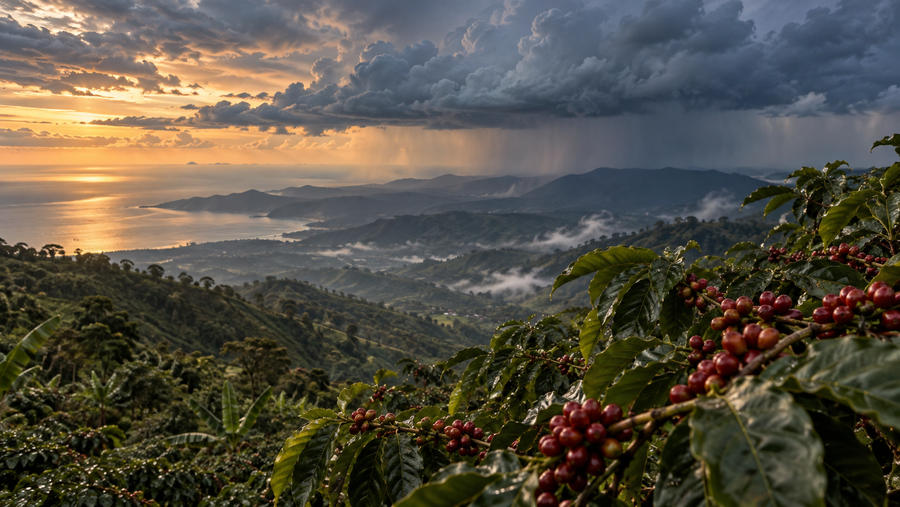
Climate conditions influence the entire coffee-growing cycle, from flowering and fruit development to harvest. Photo: USDAgov / Wikimedia Commons (Public domain).
Rain after a dry period can trigger coffee trees to flower at the same time. If too little rain arrives during flowering, fewer blossoms may open and fewer cherries may form. Heavy rain during harvest can knock ripe fruit from trees or slow the drying process. Prolonged heat and drought can place trees under water stress, affecting both the current crop and the following season.
When does the rain arrive? How long does it last? Does it coincide with extreme heat?
Coffee is a perennial crop, so the effects of one weather shock do not always end with a single harvest. If severe drought weakens the trees, recovery can take several years. If trees die and must be replanted, producers have to wait for new plants to reach productive maturity.
Why is 2026 receiving so much attention?
The current El Niño is forecast to develop into a very strong event toward the end of the year. That timing overlaps with crucial stages in the coffee calendar: flowering and early fruit development for Brazil’s next crop, and the seasonal rainfall cycle across Southeast Asia.
The phrase “Super El Niño” does not guarantee extreme damage. Local effects vary by region, elevation, and the stage of crop development. That is why a single dramatic label is less useful than watching what actually happens in each origin.
The effects differ from one origin to another
Vietnam and Indonesia: drought risk for robusta
El Niño often brings hotter and drier conditions to parts of Southeast Asia. For Vietnam and Indonesia—two pillars of global robusta supply—water shortages can become a serious risk.
During the 2015–16 El Niño, severe drought left coffee farms in Vietnam’s Central Highlands struggling with water scarcity. A 2026 report from the US Department of Agriculture also identifies the possibility that El Niño-related heat and dryness could reduce coffee productivity in parts of Southeast Asia.
In Indonesia, drought associated with the 2023 El Niño delayed harvests in South Sumatra. Yet excessive rain can also disrupt flowering, ripening, and drying. For coffee, too little rain and too much rain can both create problems.
If robusta supply tightens, the effects may extend beyond instant coffee and commercial blends. Demand can shift toward arabica, placing upward pressure on the wider coffee market.
Brazil: the answer is rarely simple
In Brazil, the world’s largest coffee producer, the relationship is more complex.
Rainfall can increase in one region and decrease in another. Dry weather may support harvesting at one stage, then hinder flowering or young fruit development at the next. The International Coffee Organization (ICO) notes that the consequences for Brazil can be positive or negative depending on location, event strength, and where the crop is in its seasonal cycle.
The expected strengthening of El Niño in 2026 overlaps with flowering and early fruit development for Brazil’s next crop. Markets are therefore watching not only the beans being harvested now, but also supply from a season that has barely begun to appear on the trees.
Ethiopia and East Africa: national averages hide local realities
Across East Africa, conditions can vary sharply even within the same country.
Speaking to Global Coffee Report, coffee researcher Dr Aaron Davis described how some Ethiopian regions continued producing without serious disruption during a previous El Niño, while trees died in areas where coffee had been grown for centuries. Some of those communities faced flooding after the drought.
Labels such as “Ethiopian coffee” or “Brazilian coffee” are too broad to describe climate risk on their own. Conditions need to be understood at the level of farms, landscapes, and even individual valleys.
Prices can rise before a harvest falls
Coffee prices are not determined only by how many beans were harvested this year. Futures markets respond to expectations. If traders believe supply may tighten, prices can move before the damage—or even the weather itself—is fully known.
In May 2026, the ICO reported that concern about a potential El Niño provided some support to coffee prices late in the month. By September, the event had emerged and was continuing to strengthen. Rain—or the absence of it—across producing regions may create further volatility.
A higher coffee price does not automatically mean a better livelihood for producers.
If yields decline, a higher price per kilogram may not compensate for the smaller amount of coffee available to sell. Irrigation, water storage, shade trees, soil improvement, and replanting all require investment. Producers may also face higher labor and processing costs as they work to protect quality. There is no guarantee that gains in the market price will reach the farm.
We need to look beyond the quoted price per pound and ask a more practical question: How much coffee can a producer harvest from each hectare, and what did it cost them to produce it?
El Niño and the “2050 coffee problem” are not the same
El Niño is a natural climate pattern that returns every few years. The long-term concern often described in Japan as the “coffee 2050 problem” is different: it refers to the ways human-caused climate change could alter the areas suitable for coffee cultivation over decades.
They are not the same phenomenon. But they can overlap.
When a strong El Niño occurs against a background of rising average temperatures, increasing drought risk, and more frequent extremes, the stress on farms can intensify. A region may once have been able to recover from a difficult season every few years. If the next shock arrives before trees and farmers have recovered, continuing with the same production system becomes much harder.
A 2023 study in PLOS Climate found that climate hazards and compound events increased across all 12 major coffee-producing regions studied between 1980 and 2020. Five of the six most hazardous years occurred after 2010, and ENSO was identified as a major driver of year-to-year compound risk.
El Niño is not the cause of every change associated with 2050. It is closer to a stress test—one that reveals where the coffee sector is most vulnerable in a warmer world.
Protecting more than the volume of coffee
There are ways to adapt.
Shade trees can reduce heat across a farm and slow the loss of moisture from the soil. Ground cover and organic matter can improve water retention. Rainwater storage, efficient irrigation, and varieties with stronger resistance to heat, drought, and disease can all help. Some producers and researchers are also exploring coffee species beyond arabica and robusta.
There is no universal solution, however, and every form of adaptation requires time and money.
Responsibility cannot be placed on producers alone. Long-term purchasing relationships, transparent pricing, and investment in equipment and plant renewal can help farms do more than survive the next poor harvest. They can support quality ten and twenty years from now.
Connecting changes in the ocean to the cup in front of us
No one can yet predict exactly how far this El Niño will reshape the 2027 harvest or coffee prices.
Uncertainty, however, is not a reason to do nothing.
We can learn where coffee comes from. We can pay attention not only to prices but also to producer yields and costs. We can support climate-resilient farming through consistent, long-term relationships. And as coffee drinkers, we can recognise that the value of a cup cannot be measured by low prices alone.
What this means for 2050 coffee
2050 coffee cannot remove climate risk. What we can do is make the journey behind each cup more visible—and continue making choices that recognise the people, places, and work that give coffee its value.
- Choose sustainable, traceable coffee. We consider not only flavour and price, but also the production environment and the people behind it.
- Share the story of each origin. We go beyond a country name to communicate producers, varieties, processing methods, and the changes taking place on the ground.
- Make better coffee part of everyday life. Through tap coffee and consistent brewing systems, we aim to make specialty coffee easier to enjoy as a daily choice.

2050 coffee Shirakawa. Through tap coffee, we are working to make better coffee an everyday choice.
A shift that begins in the distant Pacific can eventually reach a farm’s flowers and cherries, move through the supply chain, and arrive in our cup. The future of coffee will be shaped by the choices we make today—what we drink, how it is produced, and how its value is shared.
Bringing the future of coffee into today’s cup.
So that coffee can still be enjoyed in 2050—and well beyond.
Sources & further reading
- WMO, “El Niño/La Niña Update (August 2026)”
- NOAA Climate Prediction Center, “ENSO Diagnostic Discussion,” 10 September 2026
- Global Coffee Report, “How Super El Niño could reshape global coffee production and prices”
- International Coffee Organization, Coffee Market Report — May 2026
- USDA FAS, “Coffee Annual — Vietnam,” 2026
- FAO, “El Niño event in Viet Nam,” 2016
- Richardson et al., PLOS Climate (2023)
- Grüter et al., PLOS ONE (2022)
- USDAgov, “Partnerships for Climate-Smart Commodities Success Stories” (Public domain)