What this article explores
- Where the $5 you pay for a coffee actually goes, stop by stop
- Why the café isn't getting rich, and who the roasters and traders are
- How a screen in New York sets the price for millions of farms
- The chain inside producing countries that most drinkers never see
- What it would cost you to pay the farmer double (about ten cents)
- Why it isn't fixed yet, and the new models being tried
▶ Watch: Who Actually Makes Money From Your Coffee? (about 7.5 minutes)
In 2025, coffee hit the highest price in its history.
And yet many of the people who grow it are still struggling to make a living.
"So where did the money go?"
Have you ever wondered that while buying a coffee? Say your cup costs $5. Of that, the farmer who grew the coffee gets a few cents.
So who got the rest? Is the café overcharging? Is it big business? Is there a villain somewhere in the middle?
Our short answer: it isn't really a who. It's the shape of the coffee trade itself. Every link in the chain does real work and carries real costs. But put the links together and the result is a system where very little money makes it back to the farm. And that system may decide whether there's still good coffee in your cup by 2050.
Let's follow your $5 back, one stop at a time, in the same order as the video: the café, the roaster, the trader, the screen in New York, the chain inside the producing country, and the farm.
A note on the numbers: like the video, we use a $5 cup to keep things simple. The split below is illustrative, based on typical café cost ratios. It isn't any specific café's figures.
Is the café getting rich?
First stop: the café. This is where most of your money stays.
But the café isn't getting rich. Here's roughly how a $5 cup breaks down:
| Where your $5 goes (illustrative) | Roughly |
|---|---|
| The people making your drink | about $1.50 |
| Rent | up to about $1.00 |
| Milk, cups, power, cleaning and more | much of the rest |
| The café's profit | often 30–50¢, on a good day |
| The coffee beans in your cup | about 20–40¢ |
So most of your $5 never leaves the building. Which means the money heading back toward the farm is already small.
We looked at why coffee prices keep rising in an earlier article, Why Coffee Prices Are Rising. This time we go further, beyond the cup, along the whole chain.
One thing worth holding onto from this first stop: because the beans are such a small part of the price, your coffee getting more expensive doesn't mean the farmer is getting more.
The roaster: a few giants set the terms
Those 20–40 cents of beans came from a roaster.
Roasters turn green coffee into the brown beans you know. Some are tiny, like the one down your street. A few are giants.
By one estimate (ING / Euromonitor, 2022), Nestlé alone accounts for about 22% of global retail coffee sales by value. That's roughly one in every five dollars spent on coffee in shops worldwide.
Big roasters buy enormous volumes. And when you buy that much, everyone who sells to you adjusts to your terms: price, quality, delivery, when you pay. Scale turns directly into the power to set the rules.
The trader: names you've never heard
Before the roaster, the coffee was bought and sold by a trader.
Ofi. Louis Dreyfus. Neumann. Sucafina. Even daily coffee drinkers have rarely heard these names.
Their reach is large. According to the supply-chain research group Trase, just ten companies handled about a third of all the world's coffee exports in 2020. The Coffee Barometer estimates that five traders may now handle around half of the green coffee trade (an estimate, not an exact count).
It isn't as simple as traders getting rich for nothing. They move coffee from farms to ports to roasters. They lend money to producers and exporters. They carry the risk when prices move. That's real work, and it costs real money.
But the price they pay the farmer starts somewhere else entirely.
Where is the price of coffee actually set?
Not on the farm. On a screen in New York.
The arabica "C" contract, traded on ICE (Intercontinental Exchange), is the benchmark for arabica coffee around the world.
Traders, roasters and investment funds buy and sell coffee contracts on that screen every day. Most of them will never touch a single bean. When funds pile in, the price jumps. When they pull out, it falls. And farmers feel every swing.
The swings are bigger than most people imagine:
- In 2001–02, coffee prices fell to their lowest in real terms in about a hundred years (ICO, FAO)
- In 2025, they hit record highs above $4 a pound ($4.24 in February and $4.38 in October, per Reuters and Bloomberg)
- On October 30, 2026, they were around $2.87, back under $3
Nearly doubling, then falling by about a third. Record prices. So farmers must have done great, right?
Before we answer that, there's one more chain to see.
The chain inside the producing country
Inside the countries where coffee grows, there's a supply chain most drinkers never see. It varies by origin, but for most small farmers it looks something like this:
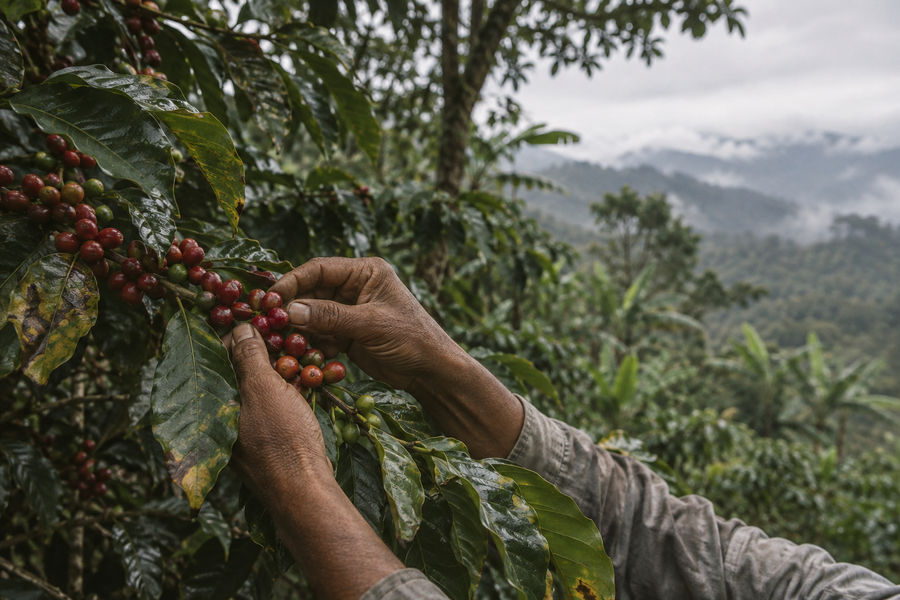
- The farmer picks ripe red cherries
- They sell them to a local collector, often the same day, because cherries spoil and they need cash
- The collector sells to a mill, which removes the fruit and dries the beans
- The mill sells to an exporter, who grades the beans, bags them and ships them
Each step takes a cut. And each step has real costs: trucks, drying beds, warehouses, interest on loans.
So the farmer's price usually works out like this:
The price on the New York screen, plus or minus a differential for quality and origin, minus every step between the farm and the port.
This is where specialty coffee is different. Buyers who pay for quality agree prices well above the screen. According to the Specialty Coffee Transaction Guide, the "C" price averaged about $2.35 a pound in 2024, while the median specialty contract was about $3.48 (FOB, meaning the price at the export port, not what the farmer takes home).
And that price is agreed up front, between people who know each other's names. When the screen crashes, it doesn't have to crash with it.
But specialty is still a small slice of the world's coffee. For most of the world's roughly 12.5 million coffee farms (ICO estimate), the screen in New York still decides their year.
Record prices. Did farmers do great?
Back to the question.
Some did better. But fertiliser went up. Labour went up. Transport went up. And a price that can nearly double, then fall by a third, makes it almost impossible to plan, to invest, or to replant.
In a 2024 study of farmers in Colombia, Honduras and Guatemala (Frontiers in Sustainable Food Systems), between a quarter and a half couldn't cover the full cost of growing their coffee.
In many coffee regions, young people are leaving for the cities. A farm that can't pay a living is hard to pass on. That isn't only the farmers' problem. It's a problem for the coffee we'll be drinking in ten or twenty years.
So back to our $5. By the time it reaches the farm, it's a few cents.
Why?
The answer is in the shape of the trade
As we've seen, there isn't a villain at each stop. The café, the roaster, the trader, the collector: each has costs and does real work.
The problem is the shape you get when you join them up.
Most coffee leaves the country where it grows as a raw green bean. And most of the value is added after it leaves. Roasting, branding, the café. The steps that earn the most mostly happen in the countries that drink the coffee, not the ones that grow it.
In 2020, the ICO and UNCTAD put the coffee industry at around $200 billion a year, with less than a tenth of that staying in producing countries. (That's producing countries as a whole. It does not mean farmers get 10%.)
That shape is centuries old. And it has barely changed.
What would it cost you to pay the farmer double?
Here's the question almost nobody asks.
What would it cost you to pay the farmer double?
Here's our rough arithmetic:
- A cup uses about 15 g of roasted coffee. Roasting loses weight, so that's roughly 18 g of green coffee
- At the record commodity prices of 2025, the green coffee in your cup was worth about 15 cents (roughly 14–17¢). At late-October 2026 prices, it's about 11–12¢
- The farmer's share of that is less
- So doubling what the farmer earns from your cup would add roughly ten cents
Ten cents. You pay more than that for oat milk, or a bigger size.
For the farmer, that dime, multiplied by every cup their coffee becomes, can be the difference between replanting and giving up.
This is our own rough calculation at commodity prices. It varies a lot by origin, quality and how the coffee is traded. And there is no mechanism today that guarantees an extra ten cents would reach the farmer.
So the farmer's problem isn't that your coffee is too cheap. It's that almost none of what you pay ever gets that far.
So why don't we just fix it?
Because the price isn't set by you, or the café, or the farmer. It's set by a system: contracts, a screen in New York, the way the whole trade is built. Even if one person decides to pay more, in most cases there's no direct path for that money to reach the farm.
And now there's a new pressure: climate change. Coffee is getting harder to grow, right where the farmers with the least money live.
Brazil, for example, grows about a third of the world's coffee (USDA, 2025/26 forecast). In our own simple analysis of public climate data, about half of the land in Brazil that suits arabica today could become unsuitable, mostly too hot, by around 2050. (It's a simple model using one climate model and one scenario, and published studies give a range of numbers. We summarise the research in What Is the Coffee 2050 Problem?.)
Adapting costs money: new varieties, shade trees, new land. And the farmers who most need to adapt are the ones this system leaves with the least.
New models are emerging
Some people are trying to change the shape:
- Producing countries roasting and drinking their own coffee. Keeping more of the value-adding steps at origin. Brazil, for example, is also one of the world's biggest coffee drinkers, at about 21 million 60 kg bags a year (ABIC, 2025). (Related: When Origin Countries Roast Their Own Coffee)
- Agreeing prices directly instead of following the screen. Buyers and farmers set prices up front, not tied to New York.
- Paying for quality. Growing markets, like specialty, where quality sets the price.
Honestly, nobody knows yet which of these will work at scale.
But we do know this: the coffee in your cup depends on someone, a long way from here, being able to keep growing it.
FAQ
Q. What is the price breakdown of a cup of coffee?
A. In a café, most of the price covers the café's own costs: staff, rent, milk, cups, energy. Using typical cost ratios, in a $5 cup the beans are about 20–40¢ and the café's profit is often 30–50¢ (an illustrative split).
Q. How much of the price of coffee goes to the farmer?
A. There is no official per-cup figure. By our rough arithmetic, the green coffee in a cup is worth about 11–17¢ at commodity prices, and the farmer receives only part of that: a few cents.
Q. Who makes the most money from coffee?
A. Not one company or person. It's the shape of the trade: most of the value is added through roasting, branding and cafés, mostly in the countries that drink coffee. The ICO and UNCTAD estimate that less than a tenth of the roughly $200 billion coffee industry stays in producing countries.
Q. How much would it cost to pay coffee farmers double?
A. By our rough calculation, about ten cents a cup, because the green coffee in a cup is worth around 15¢ at commodity prices and the farmer's share is part of that. The real challenge is building a way to make sure that extra money reaches the farm.
What 2050 coffee is working toward
2050 coffee exists to build a future where we can still enjoy coffee in 2050. We look at the innovations shaping that future across five areas: species, variety, farming, process and origin. And we believe those innovations can't be separated from the shape of the trade.
1. Don't let the screen be the only thing that sets the relationship
Trying heat-tolerant species and varieties, or new ways of farming and processing, takes time and money at origin. We want to work with producers based on the value of that work, not only the number on the New York screen. A small brand can only do so much, but that's where we want to start.
2. Tell the story behind the cup, including the system
Behind every "this tastes good" is a chain like the one in this article. The point isn't to find someone to blame. It's to explain how the system works and where it falls short, including what's hard.
3. Use technology to widen the way in, and spend the time saved on people
The 2050 coffee taps are an easy way to try new coffees. The time technology saves us, we spend talking with you about the people on the other side of the cup.
Instead of seeing the price of a coffee as simply cheap or expensive, imagine where that money goes. We think that's a first step toward building the future of coffee together.
Build the future of coffee, together.
Sources
- The $5 split (illustrative): typical café cost ratios from UK and Australian café industry guides. Not any specific café's figures
- Nestlé ≈22% of global retail coffee value (2022): ING / Euromonitor estimate
- Ten companies handled about a third of world coffee exports (2020): Trase, via Daily Coffee News (Sept 2026)
- Five traders may handle about half of the green coffee trade: Coffee Barometer (estimate)
- The ICE arabica "C" contract as the global benchmark; 2001–02 lowest real prices in about a century: International Coffee Organization (2003 press release); FAO
- 2025 record highs: Reuters (10 Feb 2025, $4.24/lb intraday); Bloomberg (23 Oct 2025, $4.38/lb)
- About $2.87/lb on 30 Oct 2026: ICE arabica futures
- 2024 averages, C ≈ $2.35/lb vs specialty median ≈ $3.48/lb FOB: Specialty Coffee Transaction Guide 2024 (Feb 2025)
- About 12.5 million coffee farms: International Coffee Organization estimate
- A quarter to half of farmers can't cover full production costs (Colombia, Honduras, Guatemala): Frontiers in Sustainable Food Systems (2024)
- About $200 billion industry, less than a tenth stays in producing countries: ICO / UNCTAD presentation (Feb 2020)
- Green coffee value per cup (≈11–17¢) and the cost of doubling the farmer's share (≈10¢): 2050 coffee's own arithmetic (15 g roasted ≈ 17.6–18.8 g green × commodity price)
- Brazil grows about a third of the world's coffee: USDA FAS, Coffee: World Markets and Trade (2025/26 forecast, ≈65M of ≈179M bags)
- About half of Brazil's arabica-suitable land unsuitable by around 2050: 2050 coffee's simple analysis (WorldClim 2.1, 1970–2000 vs 2041–2060, MPI-ESM1-2-HR, SSP2-4.5; temperature, rainfall and frost)
- Brazil's domestic consumption ≈21 million bags a year: ABIC (Brazilian Coffee Industry Association, 2025)
- 2050 coffee, "Who Actually Makes Money From Your Coffee?" (YouTube, 3 Nov 2026) https://youtu.be/Cmj8CP1NFs4